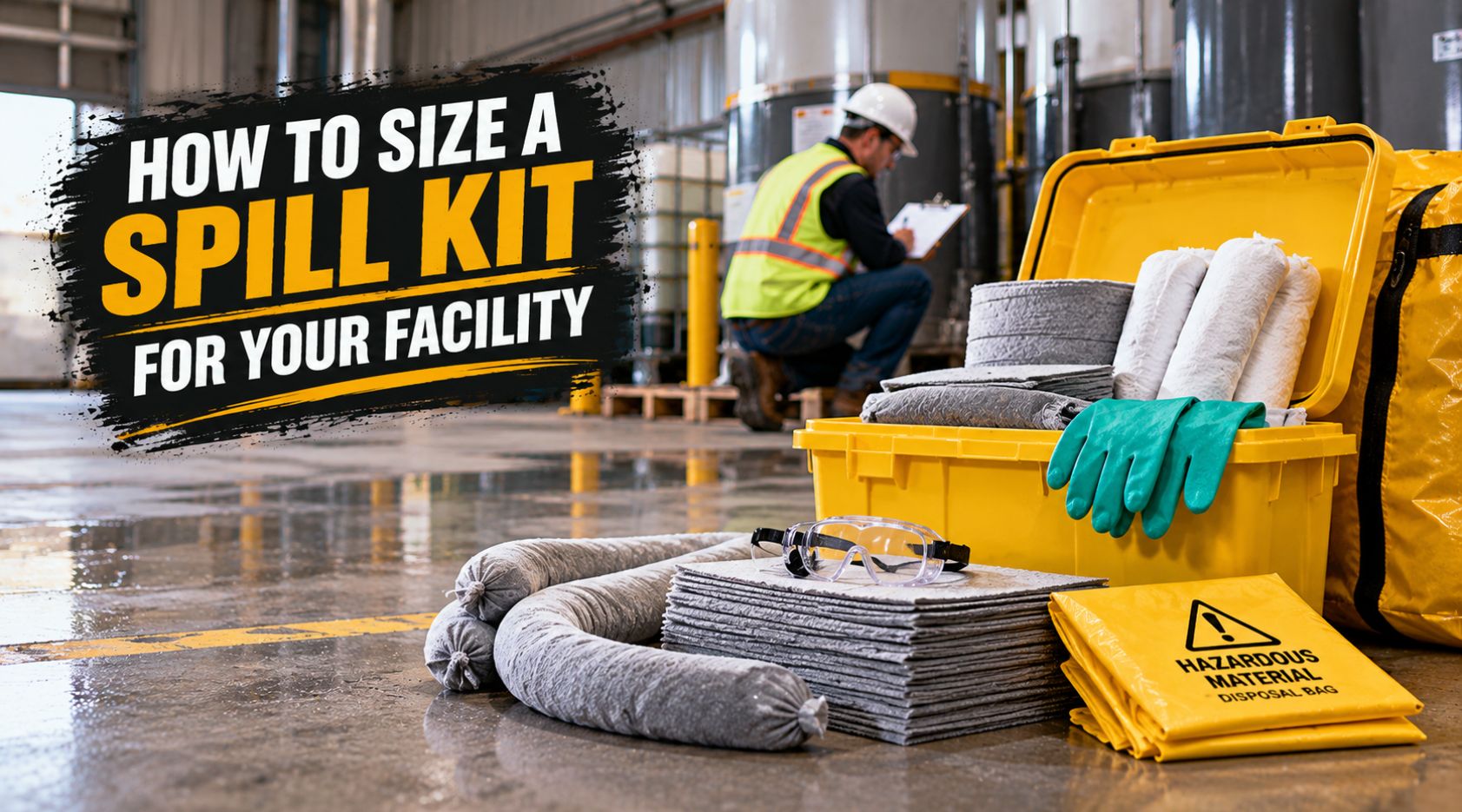
Nobody thinks about their spill kit until the moment they desperately need it, and by then it’s usually too late to wish they’d bought the bigger one. Picture it: a valve lets go, or a forklift clips a drum, and suddenly there’s liquid spreading across the floor faster than anyone expected. Someone grabs the kit off the wall, tears it open, and realizes in about four seconds that what’s inside isn’t going to be enough. That sinking feeling, watching absorbent run out while the spill keeps moving toward a floor drain, is exactly what proper sizing is supposed to prevent, and it’s a feeling a lot of facility managers only discover once, the hard way.
Plenty of facilities have a spill kit sitting somewhere, often because a checklist said to have one, not because anyone sat down and actually worked out whether its capacity matches the site’s real risk. Learning how to size a spill kit properly, instead of just grabbing whatever generic option tops a supplier’s catalog, is one of those unglamorous jobs that nobody notices when it’s done right and everybody remembers when it isn’t.
This guide walks through the practical, step-by-step process for sizing a spill kit correctly, the factors that actually drive that decision, and the mistakes that leave facilities holding a kit that looks fine on a shelf and falls apart the moment it’s actually needed.
Why Spill Kit Sizing Gets Overlooked
It’s an easy thing to get wrong, honestly. Spill kits often get bought as a compliance checkbox rather than engineered as a real response tool, and that’s understandable when a facility manager is juggling a dozen competing priorities and a kit purchase feels like a five-minute decision. The trouble is that an undersized kit does something sneaky: it creates confidence that isn’t earned. A team walks past that kit every day, sees it hanging there, and feels covered, right up until the day it turns out to hold a fraction of what an actual worst-case spill would demand.
Inspectors have gotten sharper about this too. They’re increasingly checking whether response equipment is actually sized for the materials and quantities on site, not just confirming a kit exists somewhere in the building. Getting this right isn’t only about the day something spills. It’s also about not standing there explaining to an auditor why the math behind your kit never actually got done.
Step One: Be Honest About What’s Actually Stored
Sizing a spill kit correctly starts with an honest inventory, and I mean genuinely honest, not the inventory someone assumes is still accurate from three years ago. What materials are actually stored or handled on site, in what quantities, in what kinds of containers? A facility handling petroleum products needs a different kit than one handling corrosive chemicals or a mix of materials nobody’s fully catalogued, because absorbents built for oil don’t necessarily play nice, chemically, with everything else.
This step also means facing up to whichever single container or connected system on site is the biggest one, because that container’s volume, not the comfortable daily average, is what the worst-case calculation actually needs to be built around. A facility with a dozen small drums and one large bulk tank needs to size around what that tank could release, not around the familiar, smaller volumes people deal with every ordinary Tuesday.
Step Two: Calculate the Worst-Case Release Volume
Once you actually know what’s on site, the next step is working out what a genuinely bad day looks like in numbers. That means identifying the largest tank, container, or piping run that could fail at once, and using that volume, or a defined share of it depending on the facility’s regulatory framework and how much risk leadership is willing to sit with, as the number the kit has to be able to handle.
Be conservative here. It’s tempting to assume a failure would only release a small slice of a tank’s total volume, but assuming your way into a smaller number without real engineering behind it is exactly how a facility ends up finding out, mid-incident, that its math was wishful thinking.
Step Three: Match Kit Type to Material Type
How to size a spill kit correctly isn’t only about volume, it’s also about what’s actually in the kit. Oil-only absorbents are built to soak up petroleum-based liquids while shrugging off water, which is why they belong at facilities handling fuels and lubricants, especially outdoors or near water where that distinction actually matters. Universal absorbents cast a wider net, taking on a broader range of liquids including water-based fluids, but they don’t offer that same water-repelling trick. Hazmat-rated kits exist for the aggressive stuff, acids and corrosives, using materials specifically built to survive contact with them instead of degrading on first exposure.
Get this part wrong and even a perfectly sized kit falls apart in practice, since an absorbent that isn’t chemically compatible with what’s actually spilling can react badly, break down fast, or simply refuse to do its job no matter how much of it is sitting there.
Step Four: Account for the People and Time Involved
Kit sizing doesn’t happen in a vacuum, disconnected from how the facility actually runs day to day. How fast can someone realistically reach the kit? How many trained people are typically on site, and does that number hold up at 2 a.m. on a skeleton night shift the way it does during a fully staffed day? These questions decide how much capacity genuinely needs to be within arm’s reach versus how much can reasonably sit in reserve elsewhere.
A single, centrally located kit sitting a long walk from a remote storage area offers less real protection for that area than its total capacity suggests on paper. Once a spill actually starts spreading, the minutes it takes someone to physically get there matter just as much as how much absorbent is in the box.
Step Five: Build In a Safety Margin
Sizing a kit exactly to the calculated worst case, with nothing extra, leaves zero room for a spill that runs slightly bigger than modeled, absorbent that’s degraded sitting in storage, or a response that doesn’t go as smoothly as it did in the tabletop drill. A reasonable buffer above the worst-case number isn’t paranoia, it’s just acknowledging that real incidents rarely unfold as cleanly as the spreadsheet predicted, and that extra margin is a small cost next to what an undersized response actually costs when it fails.
Spill Kit Sizing Factors at a Glance
| Factor | What to Assess | Why It Matters |
|---|---|---|
| Material type | Petroleum, universal, hazmat/corrosive | Determines absorbent chemistry and kit type |
| Largest container volume | Biggest tank or connected system on site | Drives the worst-case release calculation |
| Container and storage layout | Number and location of storage points | Affects how many kits and where they’re staged |
| Personnel and response time | Staffing levels, shift coverage, distance to kit | Determines how much capacity must be immediately accessible |
| Safety margin | Buffer above calculated worst case | Covers degraded absorbent, imperfect response, larger-than-modeled spills |
Common Spill Kit Sizing Mistakes
Buying one generic kit size for every storage area, regardless of what’s actually happening in each one, is probably the most common mistake out there, because it treats risk as uniform when it almost never is. A loading dock handling bulk fuel transfer has nothing in common, risk-wise, with a small parts-washing station holding a few gallons of solvent, and pretending otherwise for the sake of convenience usually catches up with you eventually.
Sizing around average handling volumes instead of worst-case scenarios is another trap people fall into without noticing. A facility that mostly handles small quantities but occasionally takes a large bulk delivery needs to size for that occasional bulk delivery, because the comfortable daily average was never the thing actually putting the site at risk.
And then there’s the kit nobody’s looked at in years. Storage capacity grows, new materials show up, layouts change, and the original sizing quietly stops matching reality while the kit itself just keeps hanging there looking adequate. It was probably fine when someone first installed it. That doesn’t mean it still is.
Reassessing Sizing Over Time
Spill kit sizing isn’t something to calculate once and file away. Facilities that genuinely stay prepared tend to revisit it whenever storage capacity changes, new materials get introduced, or a near-miss reveals a gap nobody saw coming. Our broader guide on spill containment systems covers how spill kits fit into a facility’s overall containment and response strategy, which is worth reading alongside this one, since kit sizing really is just one piece of an ongoing plan rather than a purchase you make once and forget about.
Spill Kit Sizing and Regulatory Expectations
Facilities working under SPCC plans, RCRA container storage requirements, or similar state and federal frameworks often find that spill response equipment gets reviewed in the same breath as secondary containment and storage practices generally. An inspector looking at a spill prevention plan may ask directly whether on-site kits are sized for the largest container or connected system present, not just whether something labeled “spill kit” exists somewhere on the property.
That doesn’t mean every facility needs an identical, formulaic answer. Regulatory frameworks generally set expectations rather than dictating an exact absorbent volume for every possible scenario, which means the actual engineering and risk-assessment work still has to happen rather than assuming an off-the-shelf kit automatically checks the box. Writing down the reasoning behind a sizing decision, not just the kit that got purchased, tends to matter a lot during an inspection, since it’s the difference between showing real thought and admitting a guess.
Staging Multiple Kits Across a Larger Facility
For a facility with several distinct storage or handling areas, one big central kit is rarely the smartest move, even when its total capacity technically adds up to the worst-case number. Spreading appropriately sized kits across the actual risk points, a loading dock here, a bulk storage area there, a smaller maintenance station somewhere else, beats relying on someone physically hauling absorbent across a sprawling facility while a spill is actively spreading.
When staging multiple kits, size and compose each one around the risk actually present at that location rather than splitting one large calculated total evenly for convenience. A bulk fuel area and a small solvent station don’t share a worst-case volume or an absorbent chemistry, and treating them as interchangeable undoes the careful work from the earlier steps.
Things to Consider Before Finalizing Spill Kit Sizing
- Has the actual largest container or connected system on site been identified and used as the basis for worst-case sizing, rather than an average or typical handling volume?
- Does the kit’s absorbent type actually match the specific materials stored and handled at this facility, oil-only, universal, or hazmat-rated?
- Is kit placement realistic given actual response time and staffing across all shifts, not just during a best-case daytime scenario?
- Has a reasonable safety margin been built in above the calculated worst-case volume, rather than sizing to the bare minimum?
- When was sizing last reassessed, and has anything about storage capacity, material types, or facility layout changed since then?
Frequently Asked Questions
How do I know what size spill kit I actually need?
Start by identifying the largest container or connected system on site and calculating the worst-case release volume from it, then match the kit’s absorbent capacity and type to that volume and the specific materials being handled, adding a reasonable safety margin on top.
Is one spill kit enough for an entire facility?
Usually not, if the facility has multiple storage areas with different material types or if response time to a single centrally located kit would be too slow for some areas. Multiple appropriately sized kits, placed near the actual risk points, generally provide better real-world coverage than one large kit in a single location.
What’s the difference between oil-only, universal, and hazmat spill kits?
Oil-only kits use absorbents that repel water while absorbing petroleum products, making them suited to fuel and hydrocarbon handling. Universal kits absorb a broader range of liquids without that water-repelling selectivity. Hazmat kits use absorbent materials specifically compatible with aggressive chemicals, acids, and corrosives.
How often should spill kit sizing be reassessed?
Whenever storage capacity, material types, or facility layout changes, and periodically even without an obvious trigger, since a kit that was correctly sized years ago may no longer match current operations.
What happens if a spill kit is undersized during an actual spill?
An undersized kit can run out of absorbent capacity before a spill is fully contained, letting it spread further and potentially reach soil, groundwater, or a storm drain, which is exactly how a manageable incident turns into a far more serious environmental and regulatory problem.
Conclusion
Knowing how to size a spill kit correctly really comes down to treating it like the engineering decision it is, instead of a generic purchase you make once and stop thinking about. Identifying real worst-case volumes, matching absorbent type to what’s actually on site, accounting for the people and time an actual response would take, and building in a genuine safety margin are what separate a kit that looks fine on a wall from one that holds up the one day it actually matters. Revisiting that sizing as the facility changes is what keeps that preparedness real instead of letting it quietly go stale until the day someone finds out the hard way.